




Hot Tags
The Complete Buyer's Guide to Transparent Car Skylight Armor: Thickness, Material & Key Parameters
June 10, 2026


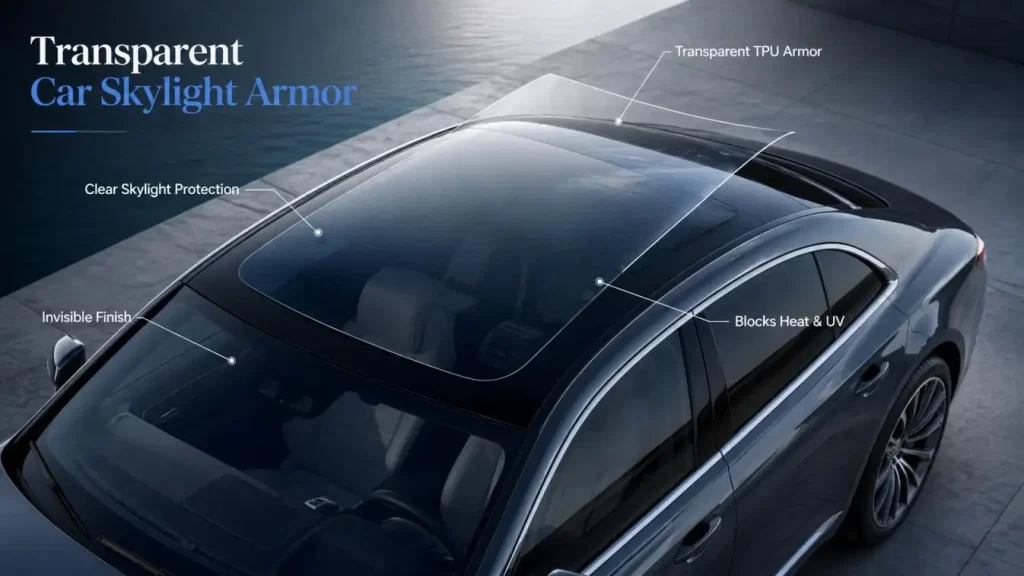
More than basic product knowledge is required for automotive professionals to make an appropriate Transparent Car Skylight Armor recommendation to their customers. They require an understanding of protection as it relates to thickness, material composition, and performance parameters. This guide will help you understand premium skylight armor films and why HEY FILM is the best choice in this growing market.
1. Why Thickness Matters: Finding the Sweet Spot
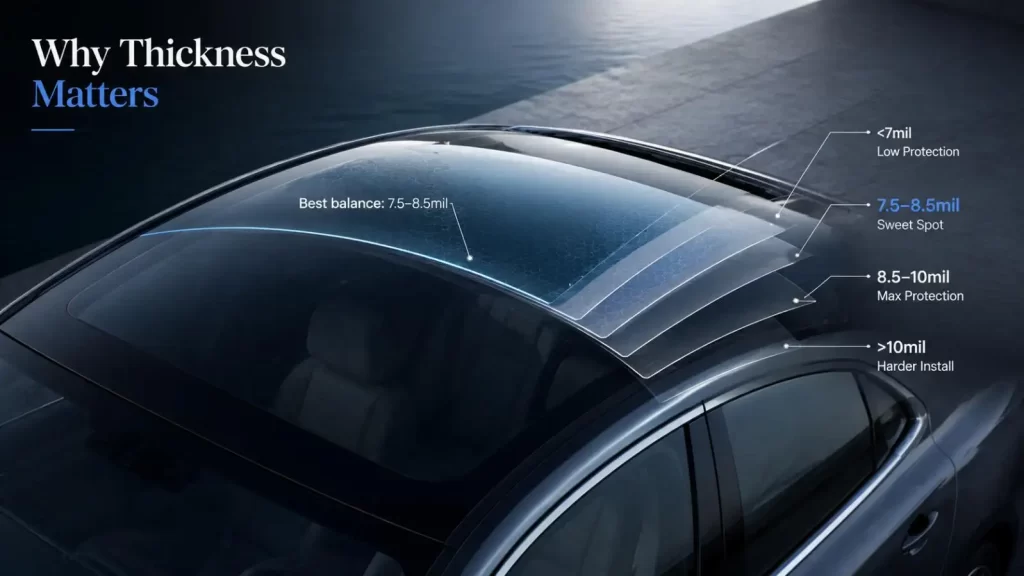
Thickness is the most visible spec in any skylight armor product description—and for good reason. Unlike traditional window tints that measure just 1.5–4mil, Transparent Car Skylight Armor typically ranges from 7.5mil to 12mil. This dramatic difference isn't cosmetic; it's the foundation of true protection.
What the numbers tell you:
• Below 7mil: Insufficient for meaningful impact protection. May resist minor scratching but offers little defense against gravel and debris and thermal stress.
• 7.5 - 8.5mil: This is the sweet spot in the industry. It provides adequate protection against stone chips and small impacts and enough flexibility to install on curved skylight surfaces.
• 8.5 - 10 mil: This range provides the most protection. This is for high impact environments or customers that want protection most. This range may include products that provide protection against explosions.
• Greater than 10mil: As protection increases, it becomes more difficult to install and increases the risk for the film to lift.
For most customers, the most appropriate range for protection and installability is 7.5 - 8.5mil. However, for customers that are on gravel roads, or that park on gravel roads, think about recommending products that are 10mil and greater.
2. Material Matters: TPU vs The Rest
All transparent films are not the same. The biggest differentiation is the raw material. The raw material will impact the longevity, performance, and satisfaction of the customer with the product.
PVC (Polyvinyl Chloride) – Do not use:
• Hard and brittle
• Will turn yellow and crack in 1-2 years
• Does not self-heal
• No longer used in most professional applications
TPH (Thermoplastic Polyurethane Hybrid) – This is a compromise and definitely not a solution:
• Only slightly better than PVC and still substandard compared to a real TPU
• Limited elasticity and recovery
• Shorter lifespan compared to most TPU-based products
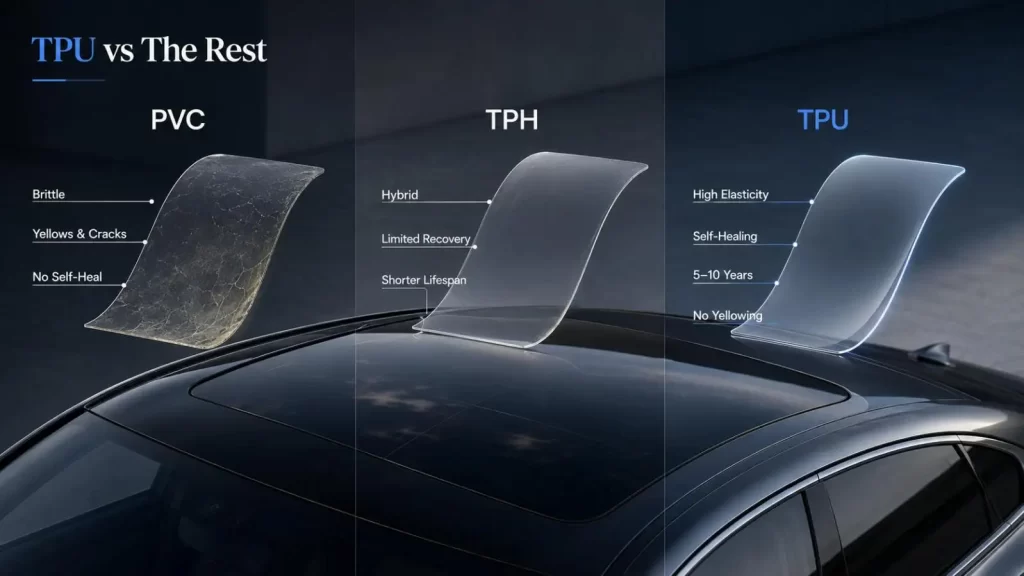
TPU (Thermoplastic Polyurethane) – The benchmark:
• High elasticity and tear resistant
• Does not yellow
• Lasts 5 – 10 years with normal use
• Self-healing
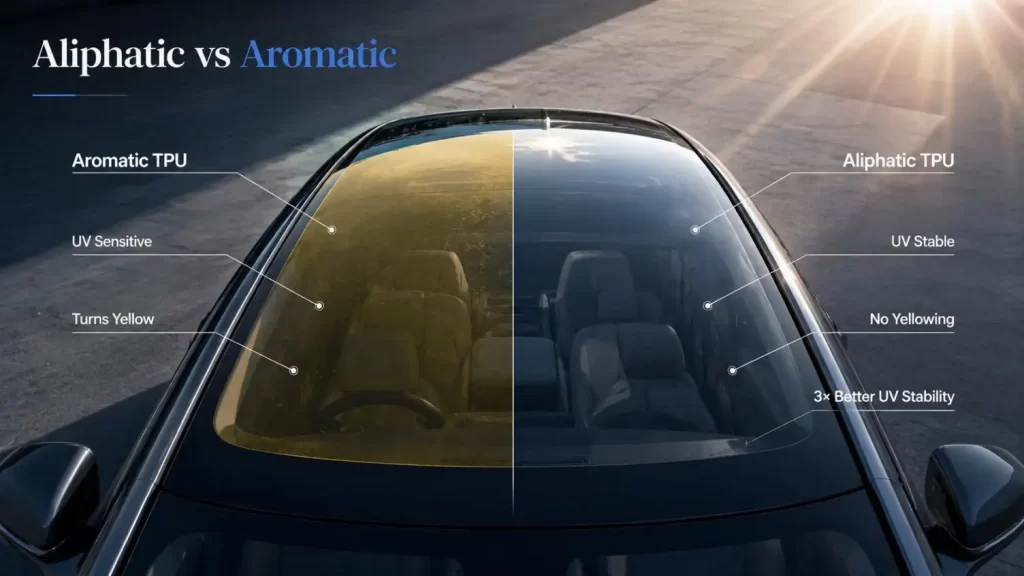
Of note within TPUs is the aliphatic vs. aromatic distinction:
• Aromatic TPU: Contains benzene rings. Very likely to degrade from UV and heat exposure. Will discolor to yellow.
• Aliphatic TPU: No benzene rings. UV stable (3x better than aromatic) and will not yellow.
Based on this, for Transparent Car Skylight Armor, we only recommend aliphatic TPUs. This will provide the 5-10 year warranty and is the only material that high-end customers expect.
3. Beyond Thickness and Material: The Critical Performance Parameters
When offering recommendations to customers, there are several important factors that, if known, will assist in recommending products that are superior to the competition. Understanding these will help in further differentiating their offering.
UV Blocking Rate
• Standard to expect: ≥99%
• Why it matters: Protects the interior from fading and reduces the risk of skin cancer.
• Premium Tier: Products That Block 99.99% UV Rays
Rejection of Infrared (IR)/ Heat Insulation
• Acceptable Range: Rejection of IR is between 90-96%.
• Why it Matters: Impacts the temperature of the cabin.
• Quality skylight armor reduces the temperature around the skylight by 8–18°C.
Solar Total Energy Rejection (TSER)
• What it is: Total solar energy blocked (light, heat, UV, etc.).
• Quality benchmark: 50–70% TSER for premium skylight armor.
• Why it matters: IR rejection is one part of the puzzle. TSER seals the deal.
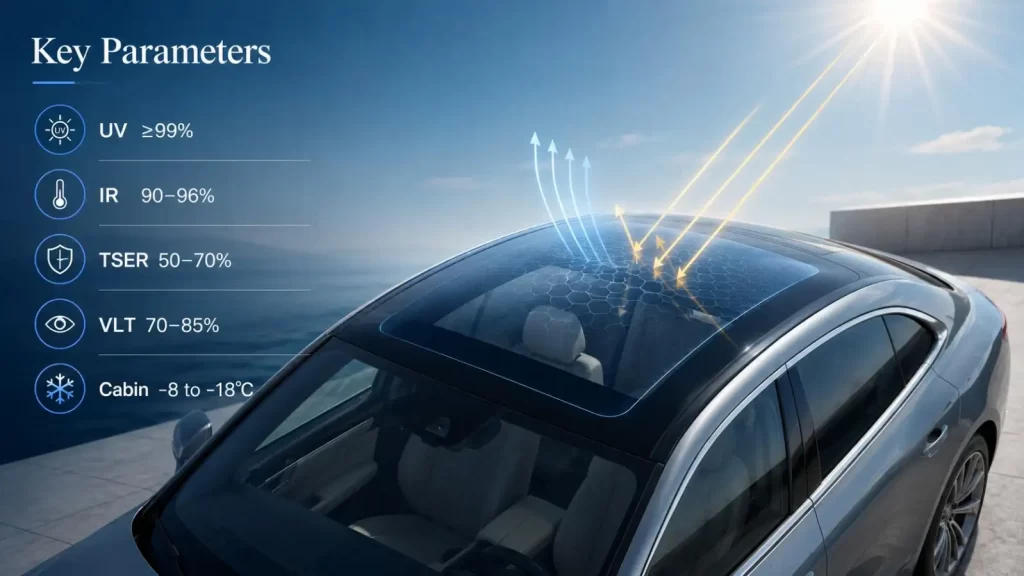
Visible Light Transmission (VLT)
• Recommended range: 70–85% for skylights.
• Why it matters: A VLT in this range retains the spacious feel of a panoramic roof.
• Professional tip: VLT's under 70% may give a feeling of darkness to the cabin and over 85% may impact heat rejection.
Self-Healing Capability
• How it works: nano-elastic coatings heat activation (via sunlight, warm water) will “erase” light scratches.
• What to communicate: Self-Healing addresses swirl marks and wash abrasion, but not deep cuts.
• Differentiation: True self-healing is heat-reactive polymers, not just surface elasticity.
Installation and Warranty: What Dealers and Installers Must Know
Transparent Car Skylight Armor is only the start. Quality installation and warrantied products is a must.
Design Considerations
• Skylight Armor Application: Skylight Armor is typically installed around the exterior frame of the skylight. The purpose is to intercept heat before it enters the cabin.
• The TPU to be used on the armor must be highly elastic (≥ 500%) since skylight materials are curved.
• Skylight Armor is best installed in a temperature controlled environment (20 to 25 degrees Celsius and relative humidity of 40% to 60%).
Why Warranties are Important
• Quality products typically have manufacturer warranties of 5 to 10 years.
• Warranties should cover yellowing, delamination, and material defects.
• A longer warranty (10+ years) shows confidence in the aliphatic TPU.
5. HEY FILM: For Demanding Dealers
When you offer Transparent Car Skylight Armor to your clients, you rely on HEY FILM for the performance, durability, and trust to create long lasting customer relationships.
• Self-Healing Hydrophobic Topcoat: washabration (wear and tear caused by the process of washing the vehicle) is less of a concern with HEY FILM. While HEY FILM remains easier to maintain, the topcoat is also glossier than traditional vinyl wraps. This gives your customers peace of mind and ensures long-term satisfaction with every installation.
• 4× Thicker Than Traditional Vinyl: The elastic TPU construction doesn't just look incredible—it provides 4× more durable protection to original surfaces. From rock chips to deep scratches, HEY FILM's skylight armor delivers defense that customers can see and feel.
• Ultra Gloss Finish: Composed of elastic polyurethane TPU, HEY FILM's products give vehicles a paint-like appearance with zero waviness or unnecessary “orange peel” textures. The clarity is exceptional—preserving the open, airy feel of panoramic roofs while adding invisible protection.
Final Word for Dealers and Installers
The Transparent Car Skylight Armor market is growing rapidly, driven by the surge in panoramic roofs and customer demand for year-round comfort. By understanding the interplay of thickness, material (aliphatic TPU), and critical performance parameters—UV blocking, IR rejection, TSER, and self-healing—you position yourself as a trusted advisor, not just a product pusher.
HEY FILM uses the latest technology with versatile uses with both automotive technology. HEY FILM gives you more options with a wider variety of VLT, greater durability, and a full range of products. With this, you can confidently suggest a solution to your customers and they will come back for more.
FAQs
Q1. What thickness of Transparent Car Skylight Armor should I recommend to most customers?
For standard recommendations, suggest armor that has a thickness of 7.5-8.5mil. This thickness provides the best balance of impact protection and flexibility on a car's skylight that is curved. If customers are concerned about their armor getting perforated due to their driving conditions, then suggest a thickness of 10mil.
Q2. Is TPU really better than PVC for skylight protection?
Yes. Compared to PVC, which can crack and discolor in 1-2 years, TPU can last 5-10 years, and is self-healing and stable under UV exposure. PVC should not be suggested under any circumstance.
Q3. How long does quality skylight armor last under normal use?
Where premium aliphatic TPU films like HEY FILM are concerned, with appropriate installation and care, they can be expected to last well beyond 10 years, and their makers warranty that.
Q4. How does the self-healing feature actually work?
Under normal circumstances, when a self-healing film is exposed to a scratch, the film relaxes its coating which has a nano-elastic property, and is instantly self-healed.
Q5. Will the film change the glass appearance or make it look dark?
No. Skylight armor will keep glass clear and allow 70-85% visible light transmission (VLT), protecting it without reducing light transmission.