




Hot Tags
Nano Ceramic Window Film: The Science, Safety, And Smart Choice For 2026
May 14, 2026


Nano Ceramic Window Film protects and enhances the interiors of cars. Many window films have metal particles in them which block signals. Because Nano Ceramic Window Film uses advanced ceramics, it protects interiors without blocking signals or visibility. When it comes to transport companies in 2026 and beyond, this material can help improve buying strategies.
What Is Nano Ceramic Window Film?
Nano Ceramic Window Film is made of layered polyester with microscopic mixtures of ceramics. These ceramics, in small amounts, are better at absorbing and reflecting infrared waves than many of their larger counterparts because, at their size, they are not able to be seen by the human eye.
Because Nano Ceramic window film has no ceramics or metals,it permits radio waves and blocks almost all infrared radiation. From then on, Nano Ceramic Window Film will enhance automotive and transport systems. Its use will be very beneficial for companies.
Differences from traditional films:
• Metalized film: Blocks heat but degrades signals and may oxidize
• Dyed film: Inexpensive but deteriorates quickly and has poor heat rejection
• Carbon film: Better heat rejection but inferior to optical clarity of ceramic
• Nano ceramic window film: Maximum heat/UV rejection, signal-friendly, remains color-stable for a long time
How Nano Ceramic Window Film Works
The reason Nano Ceramic Window Film works is due to selective spectral filtering. Ceramic nanoparticles are created to filter certain wavelengths of the solar spectrum that are primarily infrared (heat) and ultraviolet (damage). Ceramic nanoparticles allow visible light to pass freely.
When sunlight hits a nano ceramic window film three events happen:
• Reflection: Some infrared hits the film surface and bounces off
• Absorption: Ceramic particles capture heat and release it in a way that does not touch the glass
• Transmission: Visible light comes into the cabin with minimal distortion
This process helps reduces excessive solar heat gain without darkening the windows too much. Nano ceramic window films typically have a level of visible light transmission (VLT) between 20% and 70%, offering consumers some flexibility to choose what works for them in terms of privacy and legal compliance.
External resource: Learn more about solar spectral selectivity at the International Window Film Association (IWFA).
Why the 2026 Buyer Is Switching to Nano Ceramic Window Film
There are three main reasons the 2026 buyer is switching to nano ceramic technology:
• The transition to electric vehicles (EVs): Saving energy helps the range of the vehicle. Nano ceramic films help reduce the load on the air conditioner by 60%, thus promoting EVs.
• 5G antennas, V2X communications, and millimeter-wave radar all have connected vehicle systems and cannot deal with metallic interference. Nano ceramic window film preserves full signal integrity.
• Safety regulations: New glazing standards in North America and Europe require impact-resistant films for commercial fleets. Nano ceramic formulations can be engineered with thickened layers (3.5–4 mil) to meet explosion-proof criteria.
The Explosion-Proof Advantage: Thickened Nano-Ceramic Layers
For safety-sensitive applications—armored sedans, cash-in-transit vehicles, school buses, and police fleets—standard window films are inadequate. This is where HEY FILM has engineered a specialized solution: the Explosion-proof Series produced with thickened nano-ceramic layers measuring 3.5 to 4 mil in thickness.
Unlike typical 1.5-mil films, this series provides genuine shatter resistance:
• Superior impact resistance: The thickened structure absorbs energy from stones, physical strikes, or attempted intrusion
• Shatter containment: In a breakage event, the film holds glass fragments together, reducing injury risks from flying shards
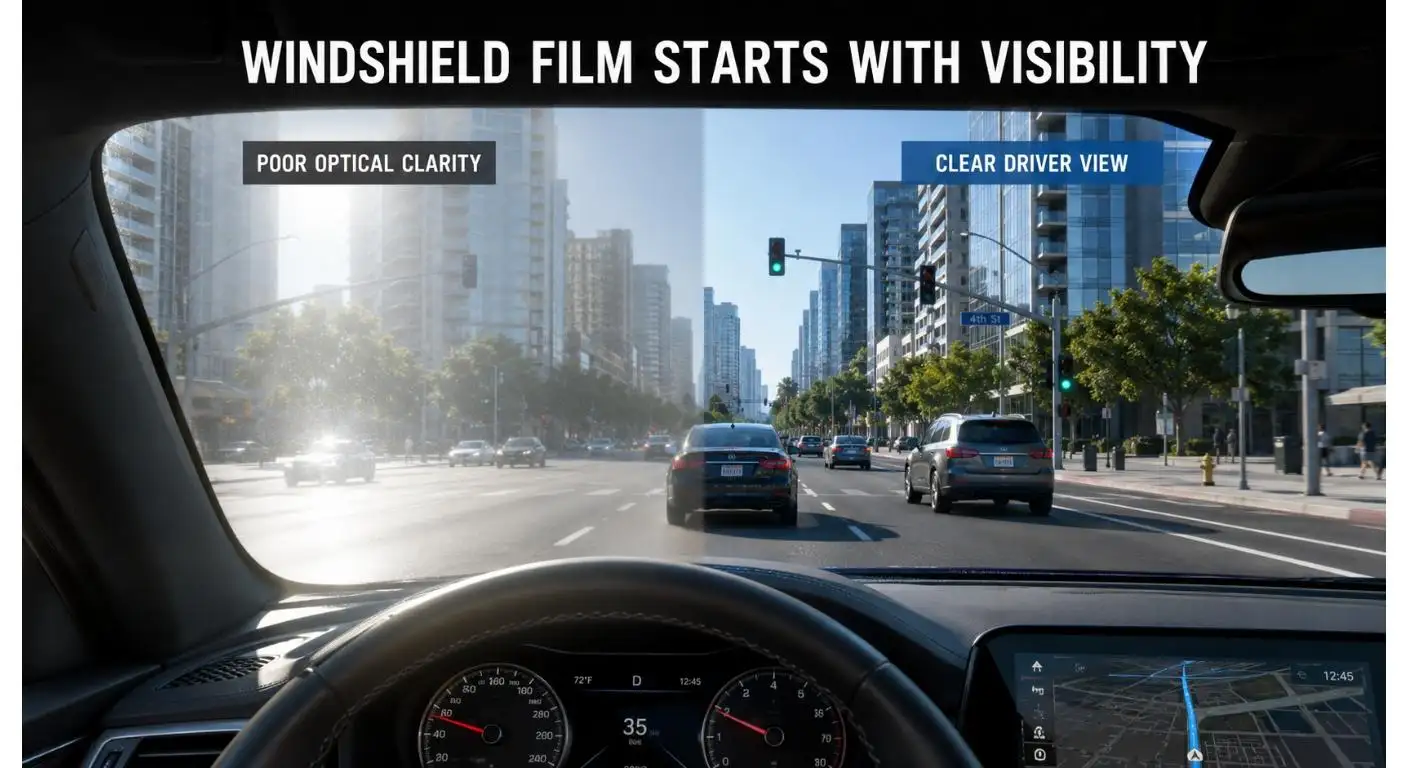
• Privacy preservation: Even with added thickness, optical clarity remains uncompromised for safe driving visibility
• Environmental durability: Performs consistently in high-heat or humid environments without curling, bubbling, or discoloration
HEY FILM's explosion-proof nano ceramic window film uses a multi-layer bonding process that increases adhesion strength between the film and the glass surface. This means the glass may crack under extreme force but will not shatter outward—a critical feature for occupant safety.
Key Benefits of Nano Ceramic Window Film at a Glance
Using bullet points with colons, here is a clear summary of what buyers gain:
• Maximum heat rejection without darkness: Blocks 85–95% of infrared heat while maintaining light transmission above 50% in many grades
• 99%+ UV blockage: Equivalent to SPF 1000+ protection for skin and vehicle interiors, preventing cracking and fading
• Zero signal interference: Non-metallic, non-conductive construction keeps GPS, cellular, radio, and toll transponders fully functional
• Permanent color stability: Ceramic particles never oxidize or turn purple, even after years of sun exposure
• Glare reduction without tinting: Cuts eye-straining glare from headlights and sunlight without needing limo-dark shades
• Shatter protection in thickened grades: When specified with 3.5–4 mil layers, the film adds physical reinforcement against break-ins and accidents
Installation and Compatibility: What Fleet Managers Need to Know
Nano ceramic window film applies to both flat and curved glass surfaces. Thanks to its flexibility and high adhesive qualities, this product works great with vans, buses, SUV's, and armored vehicles. For the most part, factory-installed glazing can receive nano ceramic film without problems; however, windows with a lot of pits or scratches should be evaluated.
Best Installation Practices:
• Seek professional installation: Because this film is susceptible to dust and poor squeegee technique, installers should be certified. Look for certified installers who can work in a clean room setting.
• Adhesive Cure: During the 3-7 day time frame it takes for the moisture to evaporate and the adhesive to completely cure, do not roll down the windows.
• If your vehicle has factory tinted, privacy glass, consult the film supplier before any heat rejection nano ceramic film application. The nano ceramic film can be stacked over the factory provided tint.
The Safety Evolution Of Nano Ceramic Film
By 2026, the inclusion of nano ceramic window film will elevate the automotive glazing standard from a premium to a baseline feature. Major automotive manufacturers have incorporated ceramic film into their warranty-backed offerings, and the aftermarket has been steadily growing at a double-digit rate.
Smart film integration, self-cleaning surfaces, and a shift in self-cleaning ceramic top coats layered over an explosion-proof base film are innovations in the glazing market.
At HEY FILM, we have maintained our own R&D and production control to ensure we are at the forefront of change in the market. Every roll of our explosion-proof nano ceramic window film undergoes a series of tests for quality. Included are tests for accelerated weathering, UV spectrometer tests, and tests for adhesion strength.
Why HEY FILM Stands Out as a Supplier
For procurement specialists, HEY FILM stands out in a saturated market. Also, in comparison to other suppliers, you get:
• Controlled Manufacturing: Manufacturing is done in-house from the ceramic to the final slitting. Manufacturing has total control over their processes and, thus, minimizes batch variability.
• Customizable Features: Order features can be adapted to your original equipment manufacturer and fleet needs, including roll width, roll length, color, and the amount of visible light transmission (VLT). Packaging needs can be customized too.
• Third-party Reports: We can provide your customers with reports from third-party labs that conducted tests for UV blockage, Infrared rejection, shatter resistance, and adhesion.
• 3-5 Year Warranty for Your Comfort: We back our products with a 3-5 year warranty against bubbling, peeling, and discoloration, plus delamination.
With the armor to protect a fleet of fifty vans, or a whole global logistics operation, you will see measurable returns from HEY FILM. Lower HVAC costs while maintaining safer and more comfortable interiors.
Ask us for technical datasheets or sample rolls. For other custom requests or to request a consultation, contact the HEY FILM engineering team.
FAQ
Q: Is nano ceramic window film worth the added expense compared to dyed or metalized film?
A: Yes. These films provide permanent color stability and an excellent 85–95% infrared heat rejection. They also allow zero signal interference. In thickened grades, genuine shatter protection is provided. Dyed films fade within 2–3 years. Metalized films block GPS and 5G.
Q: Will nano ceramic window film work on curved rear windows?
A: Yes. Not only is the film engineered with flexibility, it also can shape to both flat and curved glass surfaces without creasing, as long as it is installed by a trained professional.
Q: Does the explosion-proof series make windows look darker or cloudier?
A: No. HEY FILM's 3.5–4 mil explosion-proof nano ceramic film maintains optical clarity. Almost imperceptible to the naked eye, added thickness does an excellent job of providing impact resistance.
Q: What is the expected lifespan of nano ceramic window film?
A: Easily 5–10 years. HEY FILM provides a 3-5-year warranty against bubbling, peeling, discoloration, and delamination.
Q: Will nano ceramic film impact my vehicle's toll tag or ADAS sensors?
A: No. Because it is not a metal, nano ceramic film is completely radio-frequency transparent. GPS, 5G, and ETC along with lane departure cameras and radar all work perfectly.