




Hot Tags
A Complete Guide to Automotive Window Tint Supplier Selection
July 15, 2026


1. Why Does a Car Need Tinting Film?
Scorching summer heat, soaring cabin temperatures, UV damage to skin, and premature interior fading – these are real pains every car owner faces. At its core, window film is about selectively controlling the solar spectrum: blocking infrared (heat), rejecting ultraviolet (damage), and managing visible light (visibility).
In 2026, China's automotive window film retail market is estimated to reach RMB 38 billion, with a CAGR of 8.5%. Rapid market growth means products are increasingly mixed—knowing the facts is the only way to avoid traps.
2. Understand the Specs—Don't Be Fooled by "99% Heat Rejection" Claims
Four core parameters—none can be ignored:
| Parameter | Meaning | Reference Value | Why It Matters |
| VLT (Visible Light Transmittance) | Percentage of light passing through | the front windshield ≥70% (mandatory) | Driving safety |
| TSER (Total Solar Energy Rejection) | Overall heat rejection | Quality ≥50%, top-tier ≥60% | Real cooling effect |
| IRR (Infrared Rejection) | Heat rejection capability | Quality ≥80%, premium ≥90% | Summer comfort |
| UVR (Ultraviolet Rejection) | UV blocking capability | ≥99% | Protects skin and interior |
How TSER is calculated: TSER = IRR × 53% + (100% – VLT) × 44% + UVR × 3%. Infrared accounts for 53% of solar heat, so IRR contributes most to TSER.
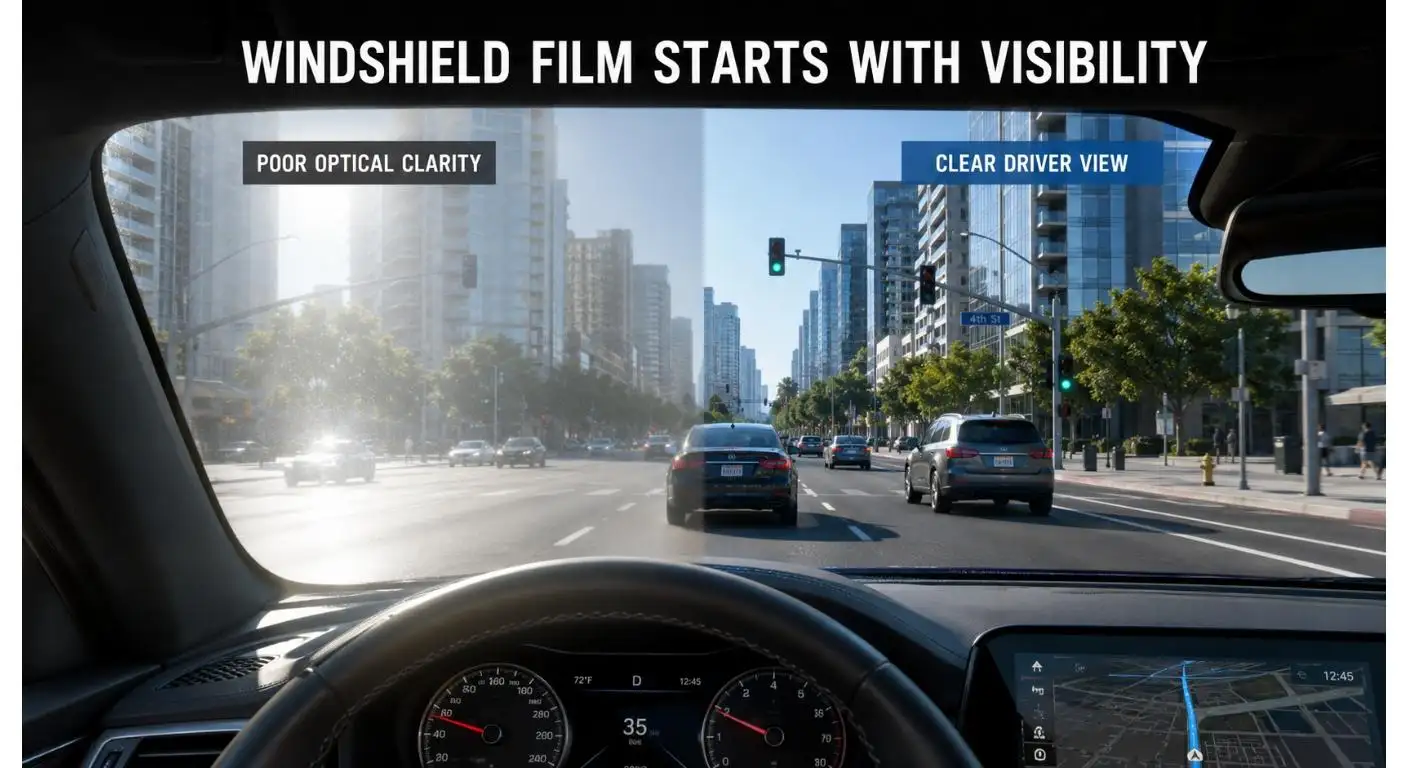
Front windshield VLT ≥70% is a legal red line. According to the mandatory national standard GB 7258-2017, the visible light transmittance of the front windshield must not be lower than 70%. Below that, it's not only illegal – it also compromises night and adverse‑weather driving safety.
3. Dyed, Metal, or Ceramic – Which Technology Route to Choose?
| Dimension | Dyed Film | Metal Film | Ceramic Film |
| Principle | Absorption (heat absorber) | Reflection (metal layers) | Selective filtering |
| Typical IRR | 30–50% | 90–95%+ | 85–92% |
| Typical TSER | 30–40% | 45–60% | 50–61% |
| Signal interference | None | May affect GPS/ETC | None |
| Durability | 1–3 years, fades | 5–8 years | 8–10 years+ |
| Best for | Not recommended | ICE vehicles, hot climates | EVs – first choice |
Bottom line: Ceramic → balanced and practical; Metal → strong heat rejection but possible signal issues; Dyed → wastes money and harms your car. With EV penetration now above 52%, ceramic films are becoming the default choice due to their inherent signal transparency.
4. The Truth Behind the Numbers – Common Misunderstandings
Myth 1: "Darker film = better heat rejection."
Truth: Heat rejection depends on IRR, not shade. A dark-dyed film may offer almost no real heat protection.
Myth 2: "Higher TSER = better film."
Truth: Always check TSER together with VLT. A low VLT can artificially inflate TSER—that's a numbers game, not real performance.
Myth 3: "Ceramic film never degrades."
Truth: Ceramic does resist oxidation better than metal, but it still degrades over long-term use.
5. Matching Film to Vehicles – System Compatibility
ICE vs. EVs: Metal films can shield GPS, ETC, and 5G signals. EVs rely heavily on electronics and connectivity—ceramic is the safer, smarter choice.
•Hot southern regions vs. four‑season northern areas: The south demands higher IRR (≥90% recommended); in the north, you can balance cost and performance.
•Front vs. side/rear windows: The front must have VLT ≥ 70%; side/rear can range from 15% to 60% VLT based on privacy preference.
6. Installation Determines the Final Result
A dust‑free workshop is a must, not a gimmick. Particles are the root cause of bubbles and dust spots.
"No rolling down windows for three days" after installation: At least 3 days in summer, extending to about a week in winter—this allows the adhesive to fully cure.
7. How to Verify Authenticity? – Standards, Certifications, and Warranties
Mandatory and industry standards you must check:
•GB 7258-2017 – mandatory safety standard (front windshield VLT)
•GB/T 31849-2015 – core product standard for automotive films
•ISO 9050 – optical performance test method
IWFA (International Window Film Association) is the global authority. Its membership includes only the world's leading manufacturers—an IWFA mark is a strong indicator of technical capability and product quality.
Electronic warranty vs. paper warranty: Only a brand‑official electronic warranty (verifiable on the official website) provides real protection – a paper warranty from a shop holds no binding power. Traceability via batch numbers is your final safeguard against counterfeit products.
8. From Product Selection to Supplier Selection – A B2B Procurement Framework
Three dimensions for supplier evaluation:
•Technical capability – Does the supplier have its own R&D team and core patents?
•Operational reliability – Stable production capacity, on‑time delivery, and quality control systems?
•Customization flexibility – OEM/ODM support?
Essential documents to request: Third‑party test reports (ASTM/ISO) and MSDS (Material Safety Data Sheet).
Why Partner with HEY FILM for Your Car Tinting Film Supply
•Foundation & Location – HEY FILM was established in 2013 in Guangzhou and has built a manufacturing plant in Huizhou, Guangdong.
•Scale & Global Reach – HEY FILM now has more than 3000 employees, exports to more than 60 countries, and has more than 198 patents.
•Product portfolio—Covers automotive transparent TPU PPF, color PPF, window film, vinyl wrap, decorative film, and building film.
•OEM/ODM capabilities – Offers professional customization services and manufactures for globally renowned brands under strict confidentiality agreements.
•Verifiable quality commitments – Backed by a 10‑12 year manufacturer's warranty, a self‑healing hydrophobic topcoat, and TPU construction that is 4 times thicker than traditional vinyl.
The end of the procurement journey is not "Who is cheaper?" – it is "Who can deliver reliable quality, consistently?"
FAQs
Q1: What is the difference between VLT, TSER, and IRR, and which one is the most important?
A: VLT is measurable for the front windshield when law requires at least 70% to pass visible light. TSER evaluates the total solar energy rejected and is the best indicator of the film's cooling performance. IRR is the measurement for heat rejection only. TSER is the most extensive measurement because it includes IR, visible light and UV. Quality films achieve TSER of 50% and the best of the best 60%+.
Q2: Is darker film always better at blocking heat?
A: No. Heat rejection is determined by IRR and TSER, not VLT (shade). A dark dyed film may only provide limited heat protection. Some manufacturers also use advanced ceramics or metals to produce lighter films with superior heat rejection. These films may have high VLT.
Q3: Should I use Ceramic or Metal films for my vehicle?
A: Metal films achieve 90-95%+ IRR with layer of metals, however, this may cause interference with GPS, ETC and 5G. Ceramic films achieve 85-92% IRR with nano-ceramic particles and are completely safe to signals. With the EV penetration reaching 52%+ , Ceramic is a better choice.
Q4: What does the term "99% heat rejection" in advertising mean?
A: This term is mostly misused. "99% heat rejection" usually applies to IRR only and not TSER. Since IRR accounts for only 53% of solar heat, 99% IRR means 50-55% TSER. This is an important difference, and always ask for TSER, not IRR.
Q5: What certifications should a reliable window tint supplier have?
A: Look for IWFA (International Window Film Association) membership, as only nine manufacturers in the world are IWFA certified. Supply ISO 9001 for quality management, and attest compliance to RoHS and ASTM test. Confirm compliance with the GB/T 31849-2015 and the GB 7258-2017 standards.