




Hot Tags
Decoding the Thickness of Skylight Armor Film: 7.5mil, 8.5mil, and 10mil Explained
June 19, 2026


As a detailer or distributor, you know the specs of the products you use have a big impact on your margins. Thickness, measured in mils, is one of the most important (and frequently misunderstood) specifications for Skylight Armor Film. Providing 7.5mil, 8.5mil, and 10mil options is about giving customers choice, but it's also about differentiating your shop as a premium solution provider, controlling your costs for installation, and optimizing your profit per vehicle.
This guide breaks down what each thickness means for your business, from purchasing decisions to workshop efficiency and customer satisfaction.
What "mil" Really Means – And Why It Matters to Your Shop
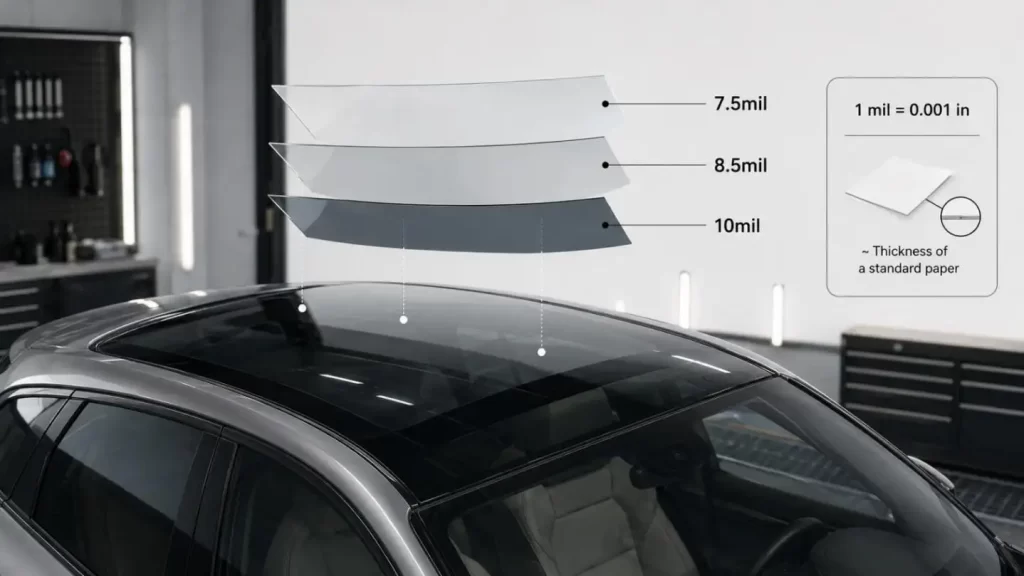
In the film industry, 1 mil = 1/1000 of an inch (≈0.0254 mm). For reference, a standard sheet of paper is about 4 mils thick. Skylight Armor Film ranges from 7.5mil to 10mil—roughly five times thicker than conventional heat-insulating films (which are typically 1.5–2.5mil).
How does this impact you as a seller?
• Perceived value: Customers tend to perceive thicker films to be more valuable, hence a higher price could be justified.
• Installation difficulty: The time and skills needed to install thicker films have to be included in your labor cost as well as the cost needed to properly train your technicians.
• Warranty claims: A thicker film of higher quality will mean fewer film issues such as bubbling, yellowing, and edge lifting. This also means fewer issues you will have to handle post sale.
The Three Thickness Tiers - A Business-Focused Comparison
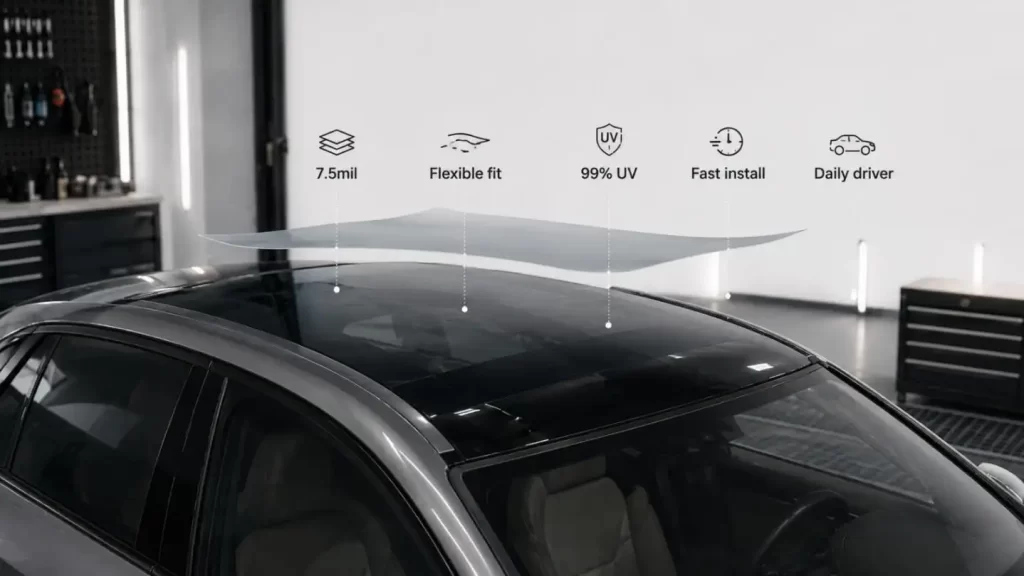
7.5mil Skylight Armor Film - The High-Volume Entry Point
• Best for: Daily driven vehicles, price sensitive customers, and repeat customers.
• Ease of installation: This is the most flexible of the three films, and therefore easier to conform to complex skylight curves. This means shorter installation time and greater throughput for your shop.
• Margins: Lower material cost lets you stay competitive and offers a good mark up. This is the best candidate for a package deal (i.e. "full car wrap + skylight").
• Customer appeal: Provides very good UV protection (≥99%) and good scratch resistance for even the most urban commuters.
• Stock recommendation: Keep this as your baseline SKU. It will account for the majority of your sales volume.
8.5mil Skylight Armor Film – The Upsell Sweet Spot
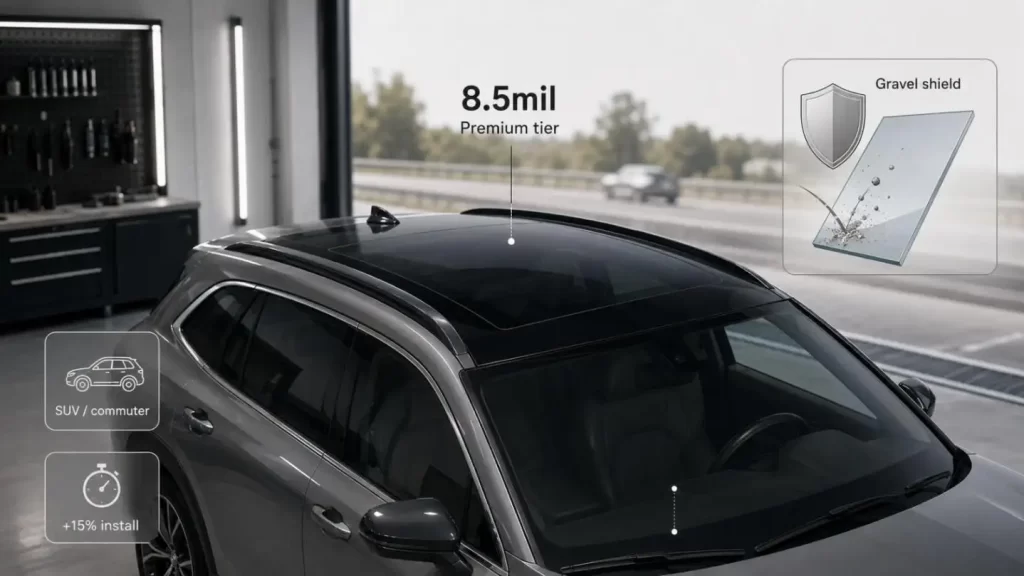
• Best for: Highway commuters, SUV owners, and customers who want "extra protection" without going top-tier.
• Installation notes: Slightly stiffer than 7.5mil—technicians need moderate experience. However, the added thickness reduces the risk of denting from gravel, a common complaint.
• Margin opportunity: The price gap between 7.5mil and 8.5mil is often larger than the material cost difference, giving you a higher absolute profit per roll.
• Differentiation: This is your go-to thickness for "premium" packages. Use it to create a clear tiered offering (Good / Better / Best).
10mil Skylight Armor Film – The Current Favorite
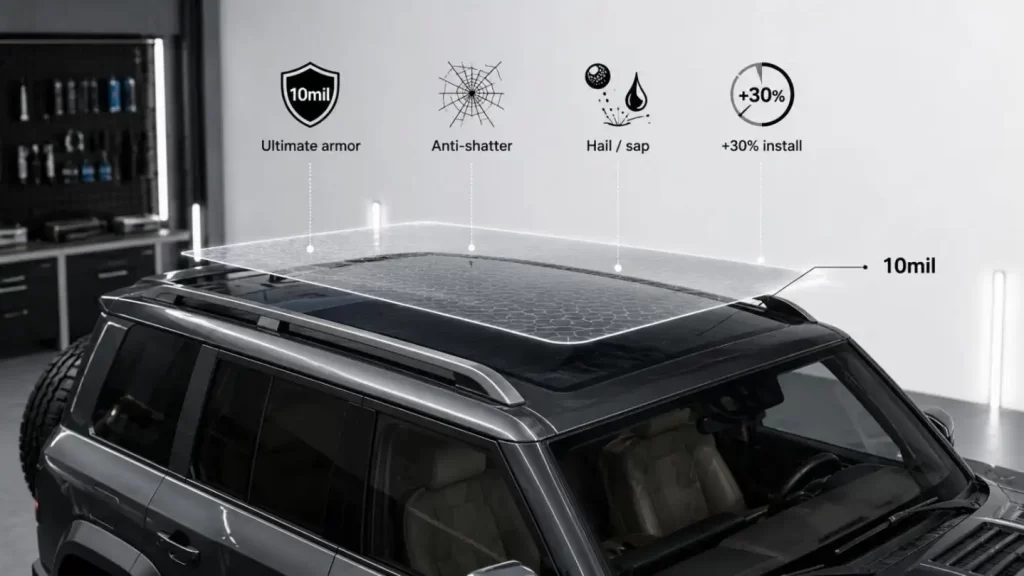
• Best Protection: Clients interested in luxury vehicles or especially in off road vehicles and customers living in areas that experience frequent tree sap or hail storm damage.
• Difficulties Associated with Installation: This option is the most difficult to install because it is the Thickest. Installation costs can be charged at a significant and high price.
• Best Margin: Although this option has the highest material cost, the significantly marked up price can be the best. The thickness also means that your shop can be the best and most high-end specialist in the market.
• Selling Tip: Family buyers of SUVs will be interested in the anti-shatter protection and enhanced safety selling point of the 10mil Skylight Armor Film.
• Role: This option should have limited supply and be special ordered. Use it to elevate your brand image, not just for volume sales.
Beyond Thickness – What Else Affects Your Profit and Reputation?
Thickness is just one variable. To protect your margins and minimize comebacks, educate your team and your customers on these equally important factors:
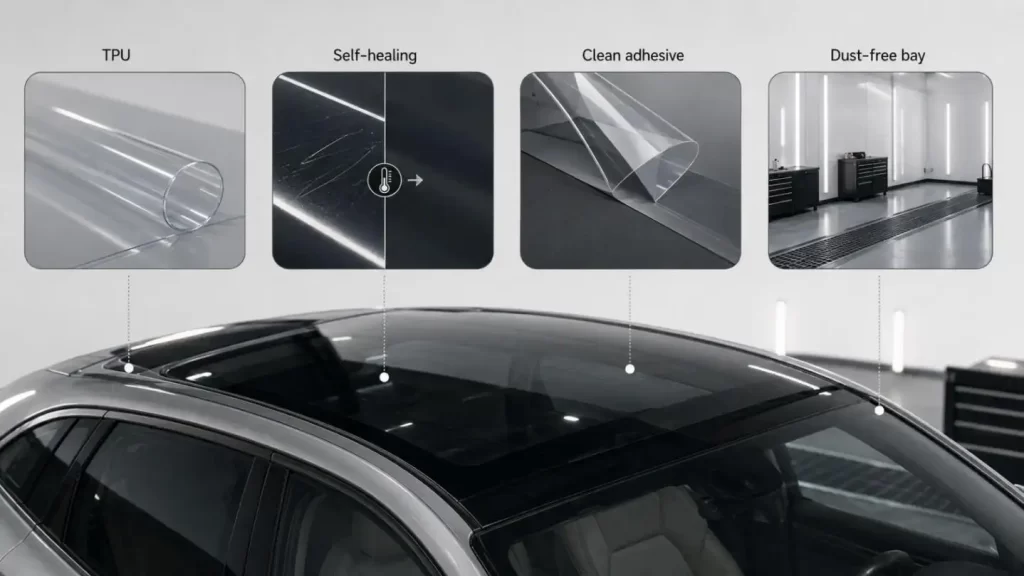
• Material purity: Genuine TPU vs. inferior TPH/PET. TPU-based Skylight Armor Film lasts longer and resists yellowing—fewer warranty claims.
• Self-ealing coating: Premium films heal minor scratches with heat. This feature reduces redo costs and delights customers.
• Adhesive quality: Low-residue, high-tack adhesives ensure no glue stains when the film is removed—a major trust-builder for repeat business.
• Installation environment: Emphasize dust-free workshops. You can charge more for professional installation, and customers will pay for the assurance.
Practical Advice for Distributors and Shop Owners
| Thickness | Target Customer | Installation Time | Suggested Retail Markup | Ideal Stock Level |
| 7.5mil | Daily drivers / fleet | Standard (~45 min) | 2.0x – 2.5x cost | High (60% of stock) |
| 8.5mil | Commuters / SUVs | +15% longer | 2.5x – 3.0x cost | Medium (30%) |
| 10mil | Luxury / off-road | +30% longer | 3.0x – 4.0x cost | Low (10%) |
Key takeaway: Don' stock all three equally. Use the table above to align inventory with your local market demand and technician skill level.
How to Pitch Thickness to Different Customer Segments
• For the budget-conscious: "7.5mil Skylight Armor Film gives you 99% UV block and daily protection—the smart choice for city driving."
• For the worried commuter: "8.5mil adds a thicker shield against highway gravel—it's our most popular upgrade for a reason."
• For the luxury owner: "10mil is the ultimate armor. It's what we install on high-end SUVs and sports cars. You'll feel the difference every time you open that panoramic roof."
Final Thoughts – Building a Profitable Skylight Armor Film Lineup
Offering multiple Skylight Armor Film thicknesses isn' just about technical specs—it's a strategic business decision. Adapting your inventory, pricing, and installation services to individual thickness tiers allows you to:
• Provide effective upselling to customers and increase your average order value
• Reduce comebacks by reducing the amount of customers who purchase the inappropriate film for their Skylight Armor
• Build your shop's reputation as a protective and value-savvy service provider
Finding the right Skylight Armor Film for your business means knowing what's best for your customers, installation time, and profit margin. 7.5mil should be your volume driver, 8.5mil for upselling, and the 10mil option should be your prestige offering.
Are you trying to understand how to choose a quality provider that delivers quality products across the board? Contact HEY FILM for sample rolls and technical training for your installers.
FAQs
Q1: How does film thickness impact time and cost of installation?
A: It does impact cost, time, and overall labor. We estimate that 10 mil film requires around 30% more time to install than 7.5 mil film. You'll want to keep that in mind for your overall labor pricing.
Q2: How does film thickness impact self-healing performance?
A: Self-healing performance is dependent on the coating technology, and is not a consideration of the thickness of the TPU base layer.
Q3: What film thickness is most appropriate for large panoramic skylight applications?
A: All three thickness options would work well, but 8.5mil would be optimal for large glass areas because it provides sufficient protection without excessive installation difficulty.
Q4: Does Skylight Armor Film provide better heat rejection at greater thicknesses?
A: No. All Skylight Armor Films would provide similar thermal performance, because heat rejection would be dependent on the infrared absorbing coating and not the thickness of the TPU.
Q5: Are wireless signals compromised at greater film thicknesses?
A: No. Skylight Armor Film is non-metallic, so it does not block wireless signals.